
Copenhagen · Denmark
 View larger
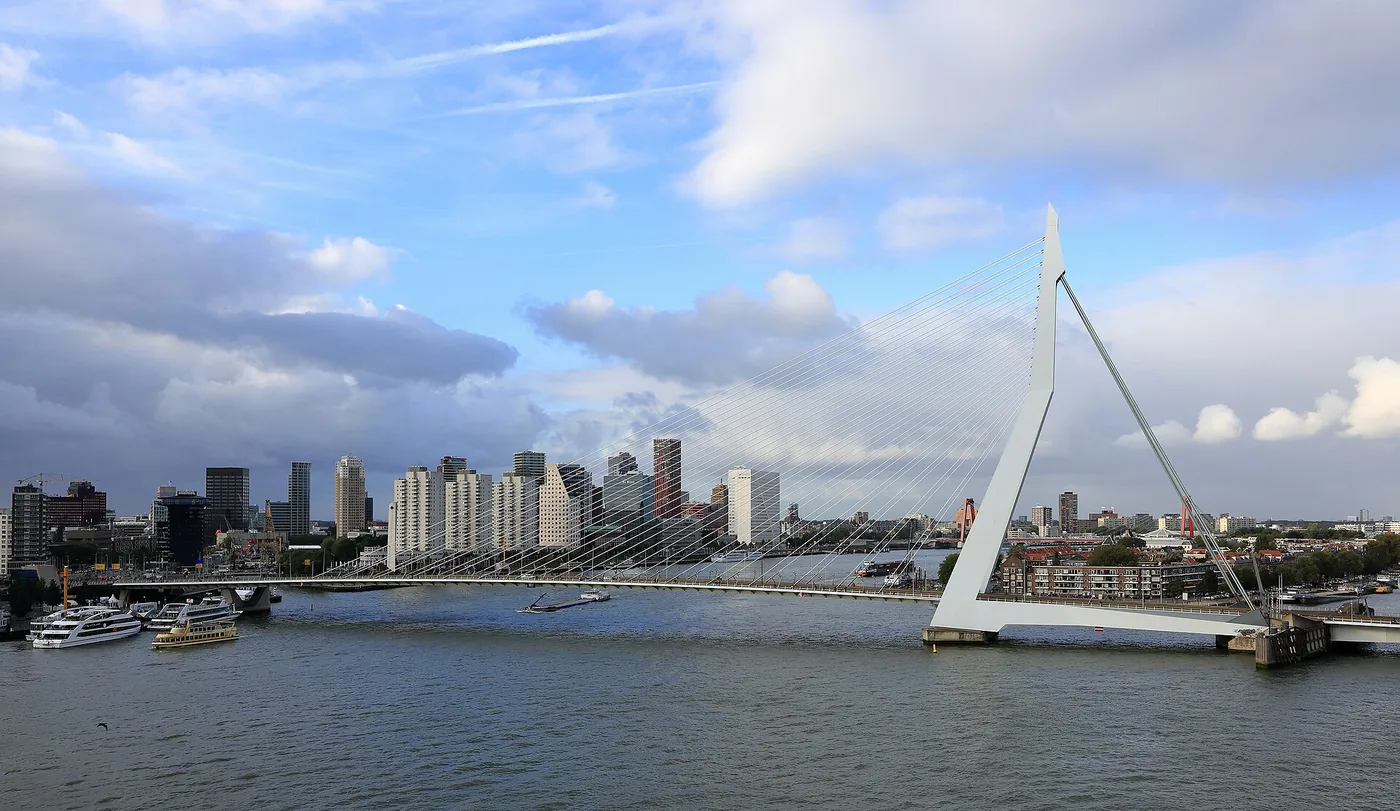
An asymmetric pylon anchors a crossing of the Nieuwe Maas.
The project, in context
UNStudio’s bridge links parts of Rotterdam across the river. Its inclined pylon and suspended deck turn a piece of transport infrastructure into a visible marker within the city’s wider landscape.
What to look for
- 01
Asymmetric pylon
- 02
River crossing
- 03
Infrastructure within the skyline
CONTINUE EXPLORING
Related works
Gateshead · United Kingdom
Stuttgart · Germany
GAD / DESIGN STUDY
Erasmus Bridge and the City Seen from a Crossing
English study · Chinese summary · · Study dated 2026-10-09
The Erasmus Bridge gives Rotterdam a landmark that is experienced both across the water and along an ordinary journey. Ben van Berkel’s design belongs to the work of Van Berkel & Bos, the practice he founded with Caroline Bos and the predecessor of UNStudio. The completed bridge crosses the Nieuwe Maas and links the centre with the southern city. UNStudio dates the project to 1990–1996. Practice history, project record.
The municipal archive places the crossing within the redevelopment of Kop van Zuid, a former harbour area. Its account records a deliberate political choice to give that connection a conspicuous architectural form. The bridge can therefore be read as a way of making an urban proposition visible: development across the river would belong to the same city. That ambition is historically documented; its effects on investment or social cohesion require separate evidence. Rotterdam’s archival history.
An outline seen in motion
The single, inclined pylon makes direction unusually legible. In an interview, Van Berkel recalls studying the bridge from multiple positions around the site and looking at the harbour’s industrial structures. Those recollections encourage a reading based on movement. A pylon that appears compressed from one riverbank opens into a different profile as the viewer approaches it. The changing relationship between tower, cables and deck gives the crossing a sequence, even though its destination remains straightforward. From either bank, the open water supplies a foreground that lets the main structural gesture be seen before the details of the deck become legible. Architect’s account of the design.
The city records an overall length of 802 metres and a pylon height of 139 metres. It also distinguishes the cable-stayed portion from the bascule section, which opens for navigation. These different systems answer two movements through the same site: travel across the river and passage along it. Architecturally, the movable part introduces a useful qualification to the familiar silhouette. The crossing is an operating piece of infrastructure whose form includes the possibility of interruption. Municipal bridge description.
Details and the working bridge
At a smaller scale, UNStudio describes individually shaped concrete piers, railings and landings. Such elements bring a very large structure into contact with the person using it. The quality of a crossing depends on these near surfaces as well as the distant outline. Engineering was undertaken by Ingenieursbureau Gemeentewerken Rotterdam, according to project credits expressly authorised by UNStudio; architectural authorship should not absorb that separate contribution. Architectural details, authorised team credits.
The opening history also deserves precision. Rotterdam’s city and archival records date the royal ceremony to 4 September 1996, while UNStudio’s later interview gives 6 September. The municipal archival date is used here. The archive further documents early wind-and-rain-related cable vibration and the subsequent installation of larger dampers. That episode makes adjustment part of the bridge’s history, alongside its celebrated form. Opening and early remedial work.
Read beside Gateshead Millennium Bridge and Arnhem Central, Erasmus Bridge offers a question for transport architecture: how can a recognisable object also organise an intelligible journey? Its strongest lesson lies in the connection between those two scales, from the skyline’s directional gesture to the details encountered during a crossing.