
Copenhagen · Denmark
 View larger
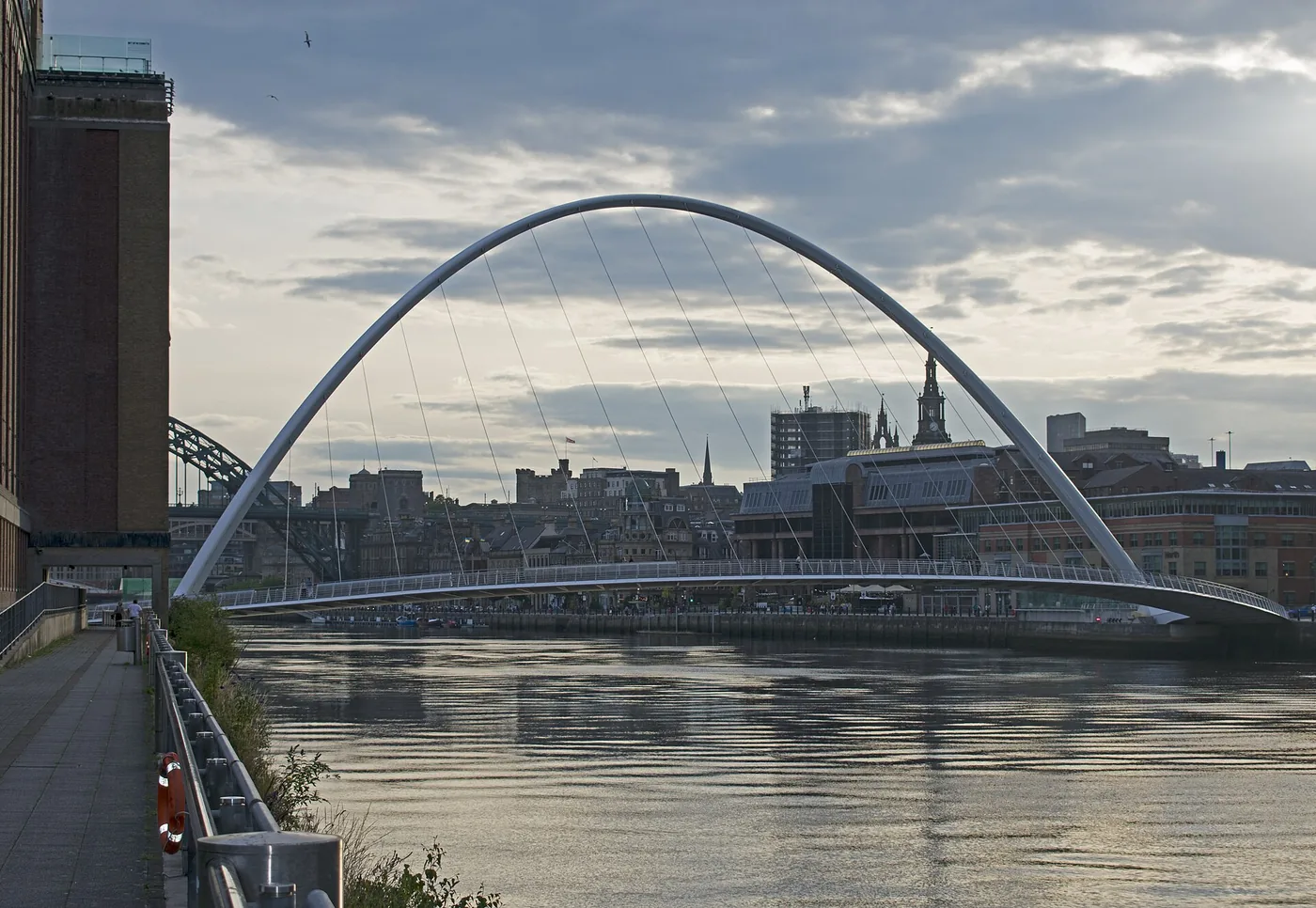
A tilting crossing for pedestrians and cyclists.
The project, in context
Two steel arches form the deck and its support over the River Tyne. They pivot together to give vessels clearance, connecting Newcastle’s north bank with the cultural quarter at Gateshead Quays.
What to look for
- 01
A moving bridge as public infrastructure
CONTINUE EXPLORING
Related works
Guangzhou · China
London · United Kingdom
GAD / DESIGN STUDY
Gateshead Millennium Bridge and the Architecture of a Moving Crossing
English study · Chinese summary · · Study dated 2026-10-06
Gateshead Millennium Bridge, completed in 2001, connects the Gateshead and Newcastle banks of the River Tyne for pedestrians and cyclists. Designed by WilkinsonEyre with engineers Gifford and Partners, it uses two linked steel arcs that rotate together to allow vessels through. The recognisable motion is not an added spectacle. It follows from a fundamental conflict between a convenient route over the river and the clearance required by traffic along it.
In its crossing position, the near-horizontal curved deck is suspended from a higher arch. Gateshead Council's account describes the cables as contributing to the stability of the deck and identifies distinct pedestrian and cycle zones. The arrangement can be read as a structure whose load path is also its public image. The walking surface and the element supporting it remain visibly related, so the bridge's outline helps explain why it takes this form.
When the bridge tilts, those elements cease to read as a deck beneath a fixed arch. They become a single moving assembly, with the downward rotation of one part accompanying the rise of the other. The architectural problem is consequently temporal as well as geometric. A drawing of the bridge in only one position leaves out an essential part of the design. Clearances, approach barriers and the changing relationship to the river must be understood through a sequence of states.
This makes the project different from a bridge that seeks the shortest possible line across water. The curved route offers changing orientations toward the banks and neighbouring crossings. Its experiential value can be analysed without claiming that every user prefers the deviation. A commuter, a cyclist and someone stopping to look at the river have different priorities. Good public infrastructure has to negotiate those differences through width, level, visibility and the management of movement, not simply through a compelling silhouette.
The tilting operation also exposes the limits of a purely visual account of accessibility. A generous crossing is only one part of a usable journey; people also need legible approaches and reliable information when it is unavailable. The design's ability to open for river traffic therefore implies a corresponding responsibility on land. This is not a claim about a particular current schedule. It is a general consequence of making a piece of everyday public circulation into a moving mechanism.
Gateshead Millennium Bridge demonstrates how infrastructure can acquire civic identity through the clear expression of a practical negotiation. Its form changes because two transport systems share the same space, and that change becomes recognisable to the city. For designers, the lesson is to assess a bridge as a sequence of relationships rather than a static object: support and deck, walking and cycling, crossing and waiting, land traffic and river traffic. Its architectural clarity comes from bringing those relationships into view together.