
Abu Dhabi · United Arab Emirates
 View larger
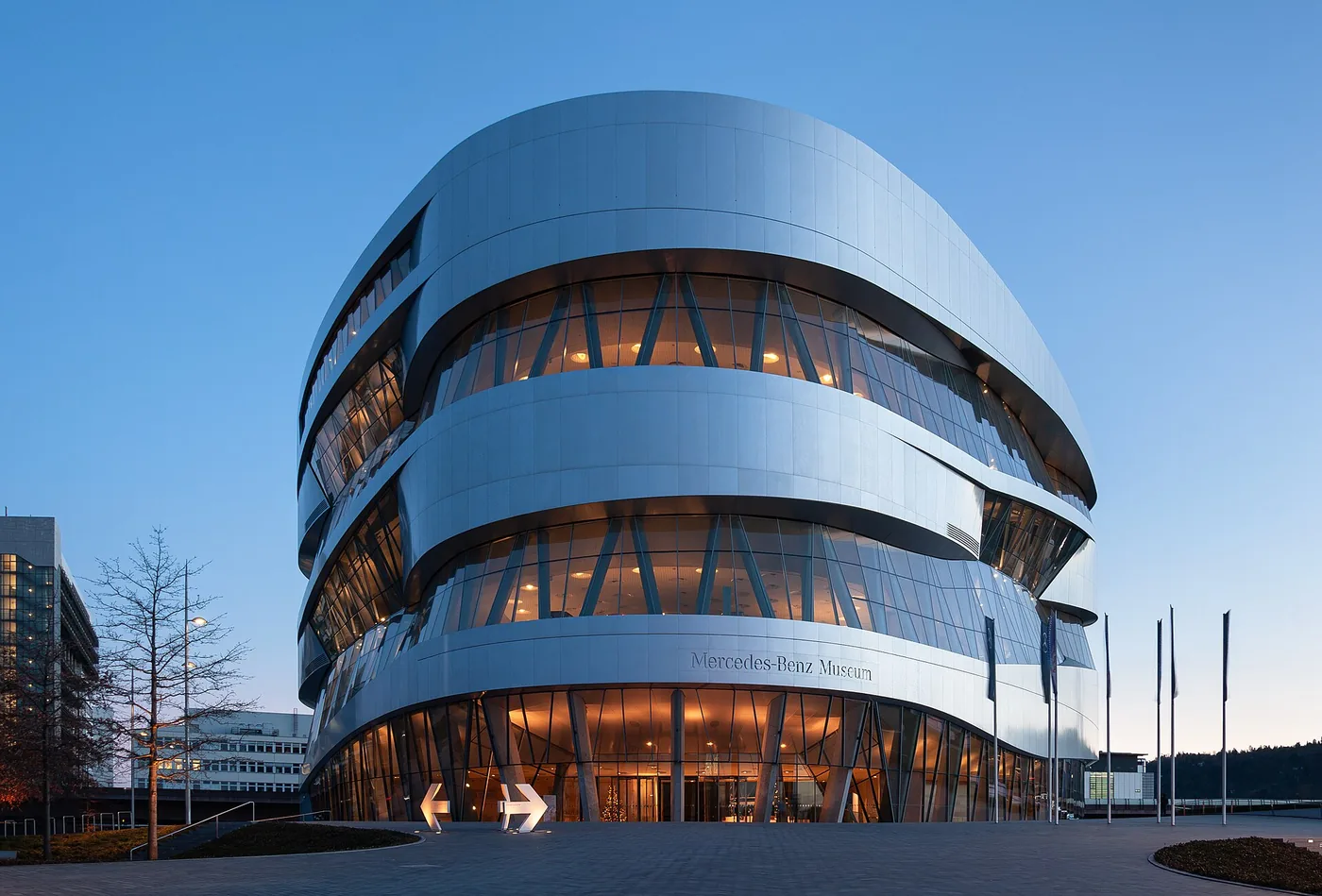
Interwoven exhibition routes around a central atrium.
The project, in context
UNStudio used a trefoil organisation to connect galleries and visitor routes. The central atrium offers visual connections and alternative paths, making movement through the automotive collection a defining part of the museum.
What to look for
- 01
Trefoil organisation
- 02
Central atrium
- 03
Interconnected visitor routes
CONTINUE EXPLORING
Related works
Rome · Italy
Paris · France
GAD / DESIGN STUDY
The Mercedes-Benz Museum and the Choice Between Two Routes
English study · Chinese summary · · Study dated 2026-10-06
The Mercedes-Benz Museum in Stuttgart, completed in 2006 by UNStudio, makes circulation the principal organiser of its collection. The building's three-lobed geometry surrounds a central atrium, while two interwoven exhibition routes descend from the upper levels. The project is useful because its unusual form is linked to a curatorial problem: how to relate a chronological account of the manufacturer to groups of vehicles that can be understood by theme or type.
UNStudio describes the visitor journey as beginning at the top, followed by two routes that cross as they descend. The museum therefore combines direction with choice. A visitor is given an overall sequence through the building but can change between different ways of reading the collection. This is more precise than calling the plan fluid. The paths need points of contact, recognisable destinations and a structure that makes a change of route possible without requiring a complete restart.
The central atrium helps make that organisation spatially apparent. Views across levels can indicate that other rooms and routes exist, while the three-part plan keeps the galleries in a recurring relationship to the centre. The geometry supplies a kind of continuity even when the content changes. Its architectural value is not mathematical complexity on its own. It is the possibility of understanding where one is within a large collection without seeing every space simultaneously.
The descending route also changes the experience of time. A conventional sequence of enclosed rooms marks progress through repeated thresholds; a ramp can make that progress more continuous. Yet continuity has costs as well as attractions. People need places to pause, routes of different lengths and ways to revisit an object without being carried along by the dominant narrative. Those are critical questions for evaluating this type of museum, rather than assumptions that an uninterrupted path automatically produces an effortless visit.
There is a second distinction between the history of an industry and the history presented by a manufacturer's museum. Architecture can support a persuasive narrative without making it comprehensive or neutral. The building's interlocking routes provide a framework for comparison, but the selection and interpretation of objects remain curatorial decisions. Recognising that limit helps separate the spatial accomplishment from the promotional language that often accompanies a corporate cultural institution.
For architects, the transferable lesson is to begin with the relationships a collection needs rather than with a spectacular circulation diagram. If visitors should be able to compare chronology and category, the routes must meet at useful moments. If a central void offers orientation, it must also preserve sufficient space and environmental control for exhibits. At the Mercedes-Benz Museum, the plan and section make those issues inseparable. The building is most convincing as an argument that movement can structure understanding, provided that choice, rest and the content of the story remain part of the design.