
Abu Dhabi · United Arab Emirates
 View larger
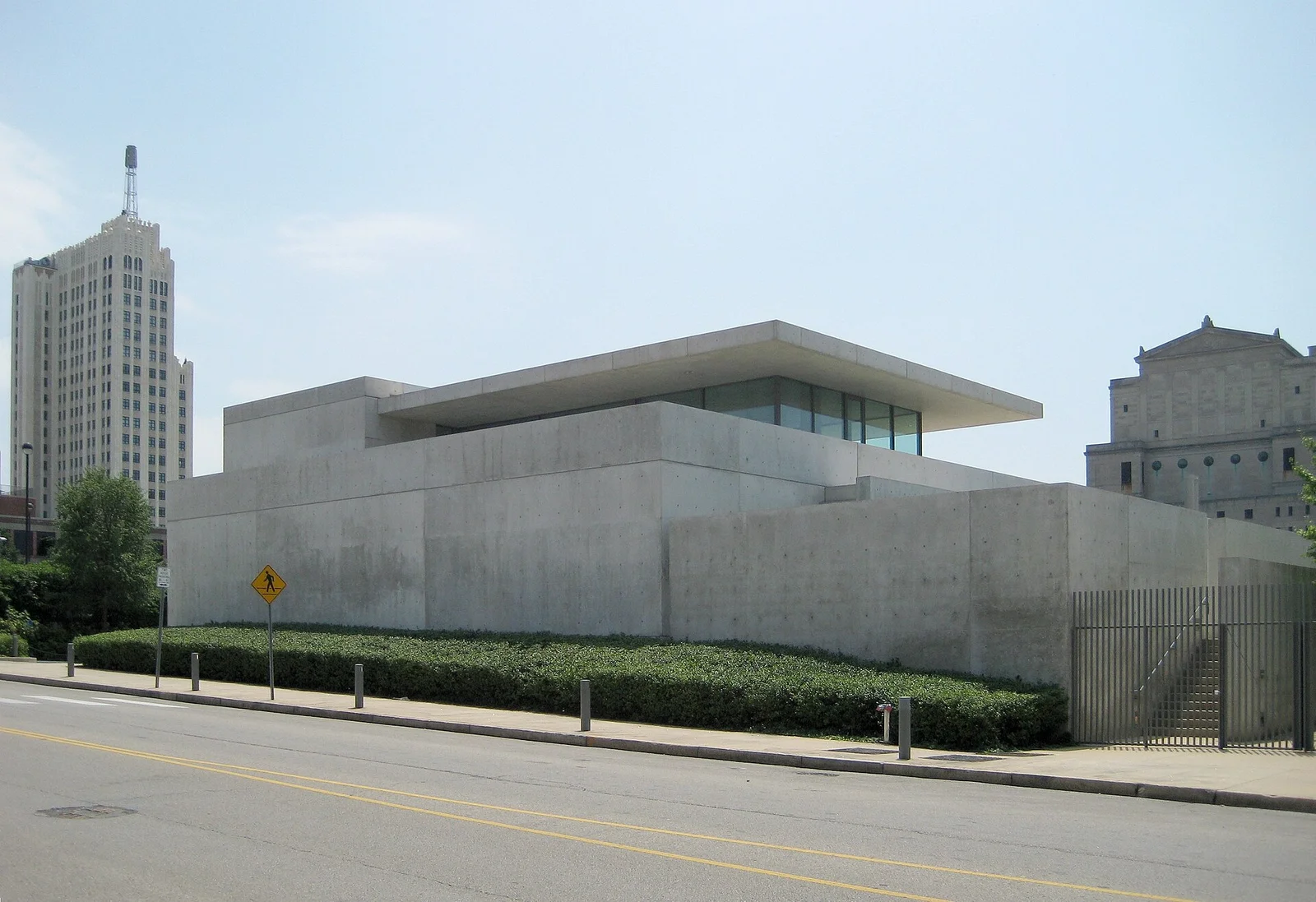
Art, concrete and water share a small museum in St. Louis.
The project, in context
Commissioned by Emily Rauh Pulitzer and Joseph Pulitzer Jr., Ando’s building opened in 2001. Its galleries and water court establish close relationships between the architecture and site-specific works, including Ellsworth Kelly’s Blue Black.
What to look for
- 01
Central water court
- 02
Controlled daylight
- 03
Architecture and commissioned art
CONTINUE EXPLORING
Related works
Rome · Italy
Paris · France
GAD / DESIGN STUDY
Pulitzer Arts Foundation and the Room Made by Art and Water
English study · Chinese summary · · Study dated 2026-10-07
Pulitzer Arts Foundation in St. Louis is a particularly concentrated example of architecture developed in conversation with art. Commissioned by Emily Rauh Pulitzer and Joseph Pulitzer Jr. in 1991, Tadao Ando’s building opened in October 2001. During that extended development, the institution evolved from a proposed home for a private collection into a museum presenting changing exhibitions. The building therefore has to reconcile a highly specific architectural character with work that does not remain fixed. Foundation history.
Two commissioned artworks make that relationship explicit. Ellsworth Kelly’s Blue Black occupies a tall wall beneath a narrow skylight in the Main Gallery, while Richard Serra’s Joe establishes another encounter with material and bodily movement. These are not merely objects placed after the room was finished. Their relationship with the institution’s architecture encourages visitors to notice scale, position and the distances needed to see. Art becomes one way of understanding the building rather than an activity that begins once architectural attention stops.
The water court introduces a different kind of presence. Its surface responds to changing light and weather, so the same opening can disclose a clear reflection at one moment and a less legible depth at another. The foundation made that condition the point of departure for its 2007–2008 exhibition Water. The courtyard was thus not simply an attractive setting beside the art; it became a subject through which an exhibition could be organised. Water exhibition archive.
Architecturally, a court of this kind provides distance without requiring a conventional gallery room. It allows looking across an interval, where the opposite wall, reflected sky and surface of the water can compete for attention. The resulting pause differs from the frontal encounter with a picture. Read as part of a sequence, it changes the pace of viewing and offers a reference point that does not depend on the current exhibition’s content.
The institution’s history also complicates the familiar description of Ando’s work as silent or purely contemplative. Ann Hamilton’s 2010–2011 installation stylus used sound, participation and accumulated materials to engage the building, extending aspects of the work beyond its walls. A precise concrete setting can support an active, time-based encounter as well as solitary looking. The architecture supplies conditions; it does not dictate a single emotional response. Hamilton exhibition archive.
This is the project’s most useful tension. A strongly authored museum can make every display seem to belong to the same architectural image, yet completely neutral space can fail to offer any particular encounter with place. The Pulitzer suggests a more productive question: how can a room remain recognisable while artists continually change the terms of its use? Its combination of commissioned works, water and temporary installations shows several possible answers. The enduring subject is not concrete alone, but the continuing negotiation between a building’s stable proportions and the different experiences assembled within them.