
Dubai · United Arab Emirates
 View larger
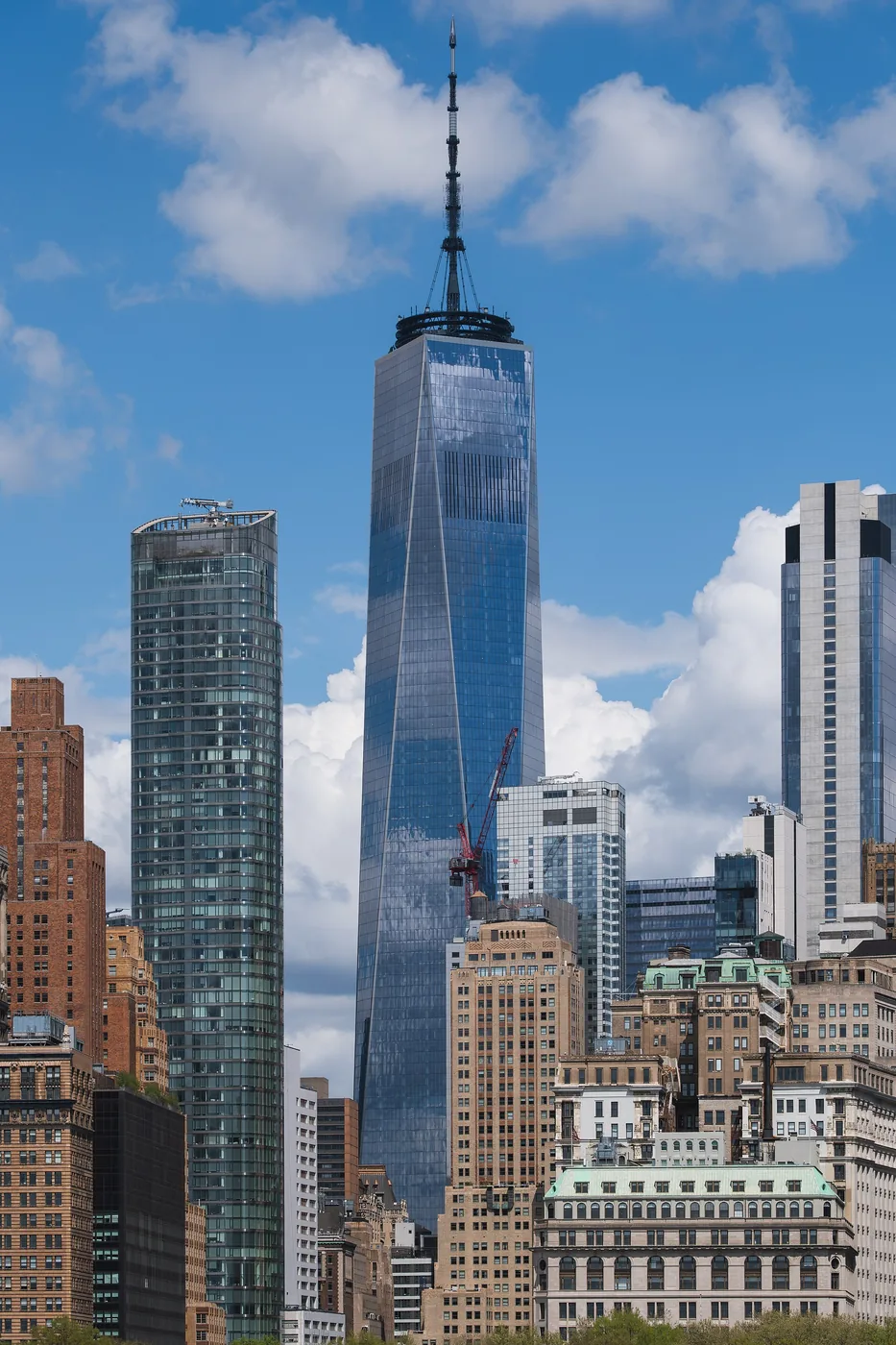
An office tower at the rebuilt World Trade Center.
The project, in context
Completed and opened in 2014, SOM’s tower combines a faceted glass form with a reinforced core. The curtain wall was developed to meet both supertall wind loads and the project’s security requirements.
What to look for
- 01
Glass envelope designed for demanding loads
CONTINUE EXPLORING
Related works
New York · United States
Lausanne · Switzerland
GAD / DESIGN STUDY
One World Trade Center Between Monument and Workplace
English study · Chinese summary · · Study dated 2026-10-05
One World Trade Center was completed in 2014 in Lower Manhattan. SOM designed the tower, with David Childs leading its design, while WSP’s project account documents the structural engineering. The building combines commercial office space with observation facilities and connections to the wider World Trade Center complex. This review concerns the tower itself; it does not attribute the surrounding memorial or the site’s entire master plan to its architects. SOM’s project record and account of Childs’s work establish the scope.
Geometry with a restrained vocabulary
The tower begins with a square base and develops through chamfered corners into an octagonal midpoint. At the upper parapet, the plan returns to a square rotated relative to the base. Eight elongated triangular faces give the exterior its faceted character. These changes allow a simple family of shapes to produce several different readings from the city.
Architecturally, the restraint is significant. The design does not depend on a sequence of unrelated formal episodes. Its identity is carried by the relationship among a small number of planes, so changing viewpoints and light can alter the apparent proportions without destroying the building’s recognisability. The result can be read as a deliberate search for composure at a site carrying unusually intense expectations.
That interpretation should remain distinct from a claim about universal public meaning. A building can be intended to express continuity or confidence without every observer responding in the same way. The architecture provides a durable, legible figure; the social and emotional meanings of the site remain broader than any single formal explanation.
A structure designed for specific demands
WSP describes a hybrid concrete-and-steel system, with a substantial concrete core and steel framing supporting large office-floor spans. The core also contains protected circulation, including a dedicated stair for first responders. These features connect the commercial requirement for workable floor space with an unusually demanding safety brief. WSP’s engineering account supplies the technical basis.
The important architectural relationship is between that internal robustness and the continuous glazed exterior. The building can appear visually light while relying on substantial structural elements within. This difference is not a contradiction to be solved by appearance alone. It illustrates how enclosure, load-bearing structure and protected circulation perform different tasks within one composition.
The base carries another scale of responsibility
SOM documents entrances on four sides and differentiated access for offices, transport and the observatory. At ground level, the building must organise people whose purposes range from daily work to a singular visit. Its civic role therefore depends on more than its contribution to the skyline.
A useful critical test is whether the transition from surrounding open space to a particular destination is understandable and proportionate to the visitor’s needs. Transparent surfaces can assist orientation, but they do not themselves establish unrestricted access. Security, signage and management remain part of the experience.
One World Trade Center is most revealing when studied across these scales. The silhouette offers geometric clarity, the structure answers a complex brief, and the entrances translate a monumental object into individual journeys. Its architectural challenge is to keep those three conditions compatible over time.