
Abu Dhabi · United Arab Emirates
 View larger
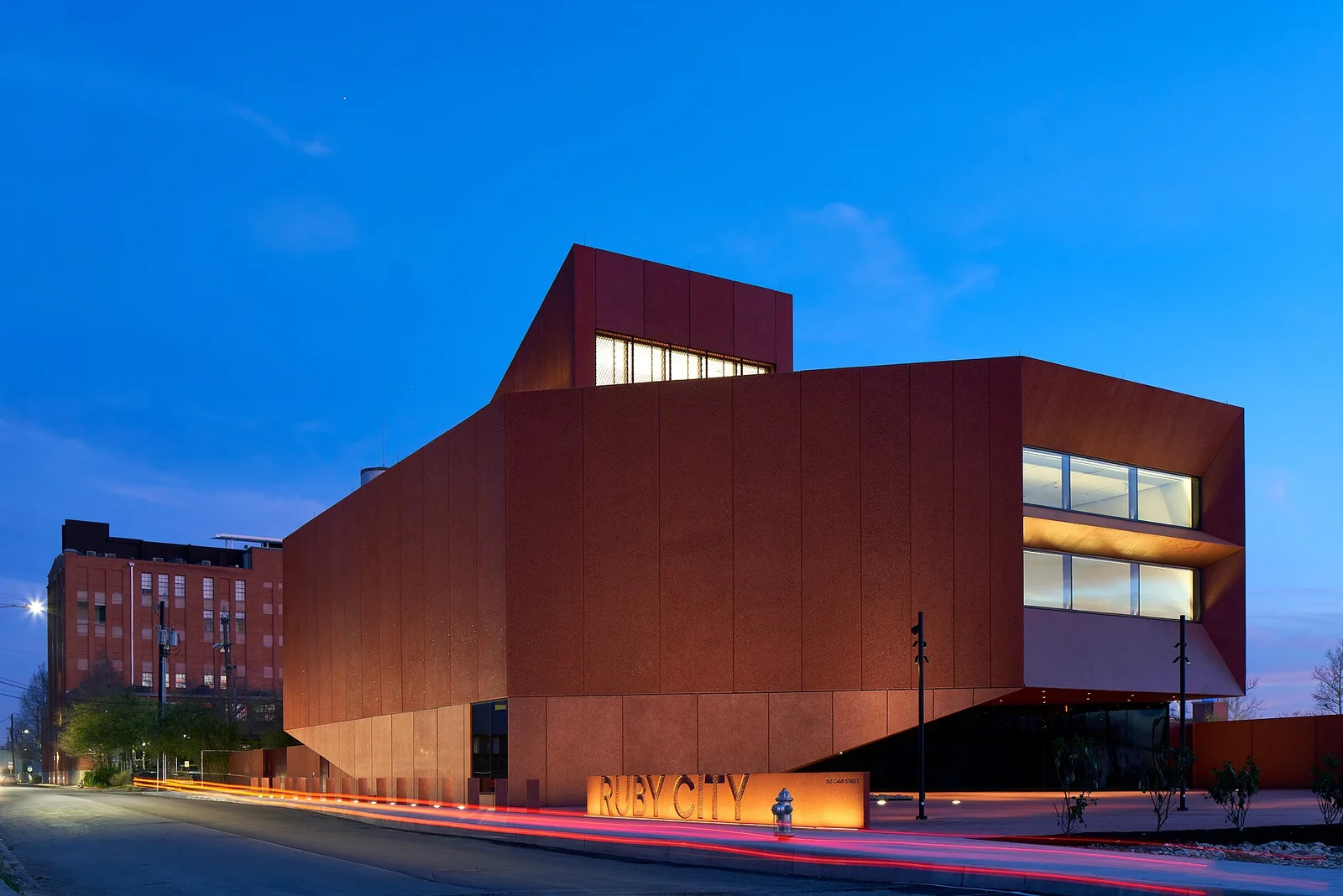
A red concrete art centre for the Linda Pace collection.
The project, in context
An ascending gallery route returns visitors to the entrance and plaza, while roof lanterns admit natural light. Adjaye Associates was design architect and Alamo Architects was architect of record.
What to look for
- 01
Roof lanterns and red precast concrete
CONTINUE EXPLORING
Related works
Rome · Italy
Paris · France
GAD / DESIGN STUDY
Ruby City and the Transition from a Red Surface to a Gallery Route
English study · Chinese summary · · Study dated 2026-10-07
Ruby City establishes a strong presence with a compact building. The contemporary art centre in San Antonio was designed by Adjaye Associates for the Linda Pace Foundation, with Alamo Architects as architect of record. It opened to the public on 13 October 2019. Its red exterior carries an image from Pace’s own dream drawing into the city, giving the institution a recognisable identity before a visitor reaches the door. Project credits; Institution’s history.
The material becomes more interesting at close range. Ruby City describes precast panels with polished lower surfaces and rougher upper areas incorporating red glass and mica. These finishes invite different readings of the same colour. From a distance, the building appears as an angular mass; near the pavement, reflection and texture bring attention to a surface within reach. In architectural terms, the change of finish acknowledges two audiences: the passer-by looking across the street and the person standing beside the wall. A single material palette can therefore establish more than one scale of encounter. Material account.
Entry begins through a sequence of light conditions. The institution explains that the overhang shades the approach after the sunlit plaza, allowing visitors’ eyes to adjust before entering. That account offers a precise way to understand the projecting upper mass. Its underside shapes the arrival experience as well as the external silhouette. A threshold can have duration: the movement from bright ground to shade prepares attention before an artwork is encountered. Here, environmental exposure and the choreography of viewing meet in the same architectural element. Arrival sequence.
Inside, the architect describes a loop that rises through separate galleries before returning to the lobby and plaza. The route makes circulation part of how the collection is encountered. In this reading, ascent establishes a modest separation from the street, while the eventual return gives the visit a clear completion. Distinct rooms can support changes of concentration along that journey. The important question is how the sequence accommodates both a visitor moving continuously and one who wants to stop, look back or spend longer with a single work. Gallery organisation.
Two roof lanterns introduce daylight, while windows reconnect the interior with Chris Park and San Pedro Creek. The building consequently offers more than one kind of visual attention. A gallery wall concentrates the eye on an object; an outward view releases it toward a larger setting. These moments can serve as intervals between exhibitions, helping visitors regain a sense of position. They also make the surrounding landscape part of the visit without requiring every wall to become transparent. The balance between enclosure and outlook is central to the building’s spatial character. Daylight and views.
Ruby City rewards a reading that follows the body through the architecture. Surface texture, shade, ascent and renewed views form successive adjustments in proximity and attention. The strong external colour draws these decisions together, but the project’s deeper lesson concerns their sequence. A small cultural building can gain spatial richness by carefully changing the conditions of looking between the pavement, the entrance and the rooms where art is encountered.